The Hidden Risk Many O&P Practices Don't Talk About
When practice leaders think about operational risk, they often think about reimbursement changes, staffing shortages, compliance requirements, or cash flow.
Those challenges are real and deserve attention.
But one of the greatest risks facing many prosthetic and orthotic practices is much simpler:
The loss of institutional knowledge.
The Knowledge That Keeps Operations Moving
Every practice has team members who carry years of experience and operational understanding.
They know how specific payers behave. They recognize denial patterns before they become trends. They understand authorization requirements, documentation expectations, workflow exceptions, and countless billing nuances that never made it into a training manual.
Over time, these employees become critical to operational success.
Not because they intentionally hold information, but because they have accumulated knowledge through years of experience solving problems and navigating complexity.
As long as those employees remain with the organization, this often goes unnoticed.
The knowledge is available whenever someone needs an answer.
Until one day it isn't.
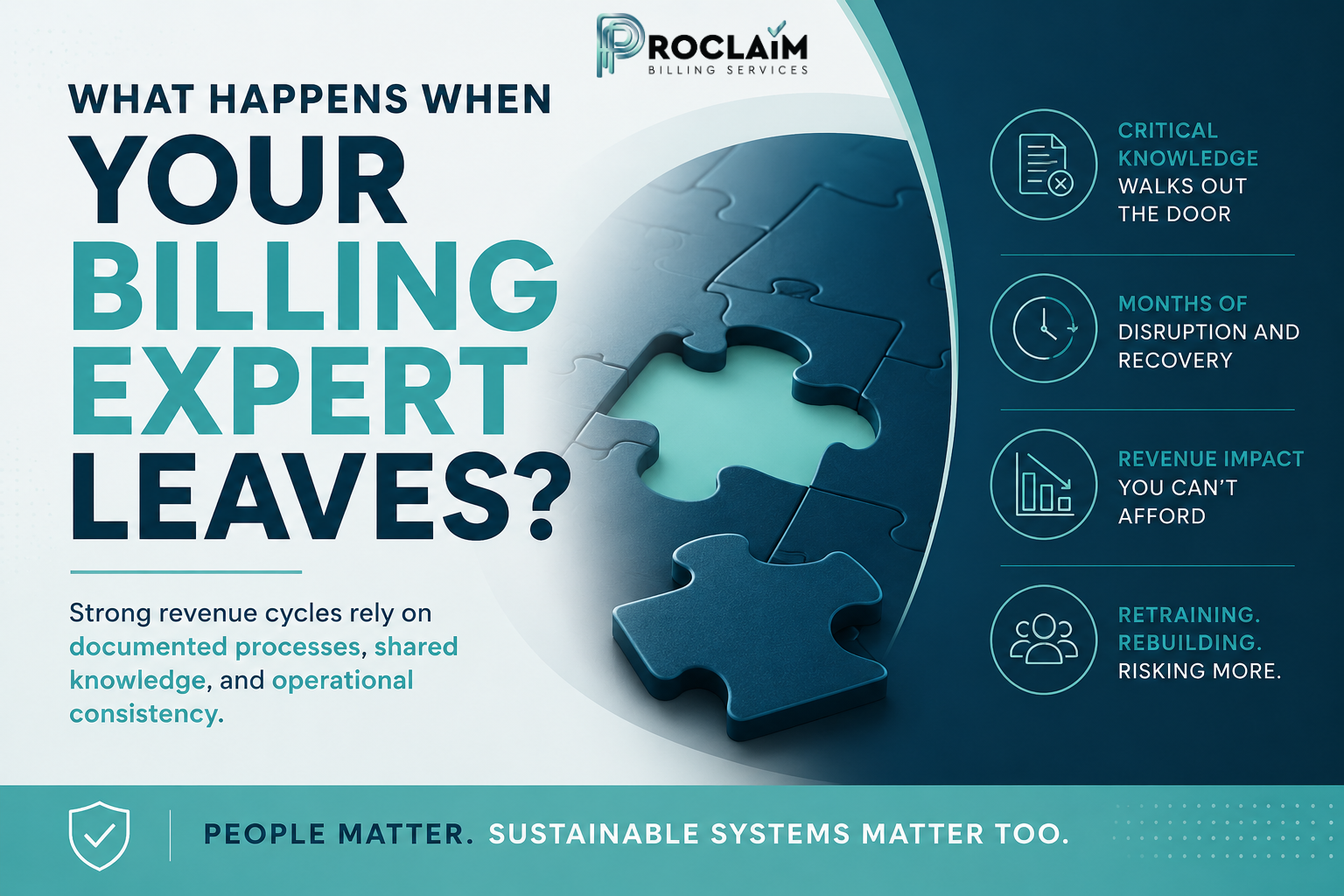
When Knowledge Walks Out the Door
Employees retire.
They accept new opportunities.
They take extended leave.
They move into different roles.
When that happens, practices can quickly discover how dependent they have become on knowledge that was never formally captured.
Processes that once seemed routine suddenly become difficult to navigate.
Questions that previously had immediate answers now require investigation.
Teams spend valuable time recreating information that already existed, but only in someone's memory.
The result can be operational disruption that affects multiple areas of the organization.
Claims take longer to process.
Workflows become inconsistent.
Training new employees becomes more difficult.
Denials increase.
Collections slow down.
What appeared to be a staffing change becomes a much larger operational challenge.
Why This Risk Is Growing
The prosthetic and orthotic industry continues to become more complex.
Documentation requirements evolve.
Payer expectations change.
Revenue cycle processes require increasing levels of specialization.
As complexity increases, so does the amount of knowledge required to operate effectively.
Without intentional efforts to capture and share that knowledge, practices become increasingly vulnerable to disruption when key employees transition out of a role.
Building Systems That Protect Knowledge
Organizations that navigate staffing transitions most successfully often have one thing in common:
They prioritize knowledge transfer before it becomes urgent.
This may include documenting workflows, creating process guides, cross-training team members, standardizing procedures, and establishing consistent operational practices.
The goal is not to replace experienced employees.
The goal is to ensure that valuable knowledge remains within the organization rather than residing with a single individual.
A Long-Term Operational Investment
Strong operations are not built solely on great employees.
They are built on systems that allow knowledge to remain within the organization, regardless of who occupies a particular role.
In today's environment, protecting institutional knowledge may be one of the most important operational investments a practice can make.
Because when knowledge is shared, documented, and embedded into the way an organization operates, stability becomes far less dependent on any one person.
And that creates a stronger foundation for long-term success.
—
The Proclaim Team