
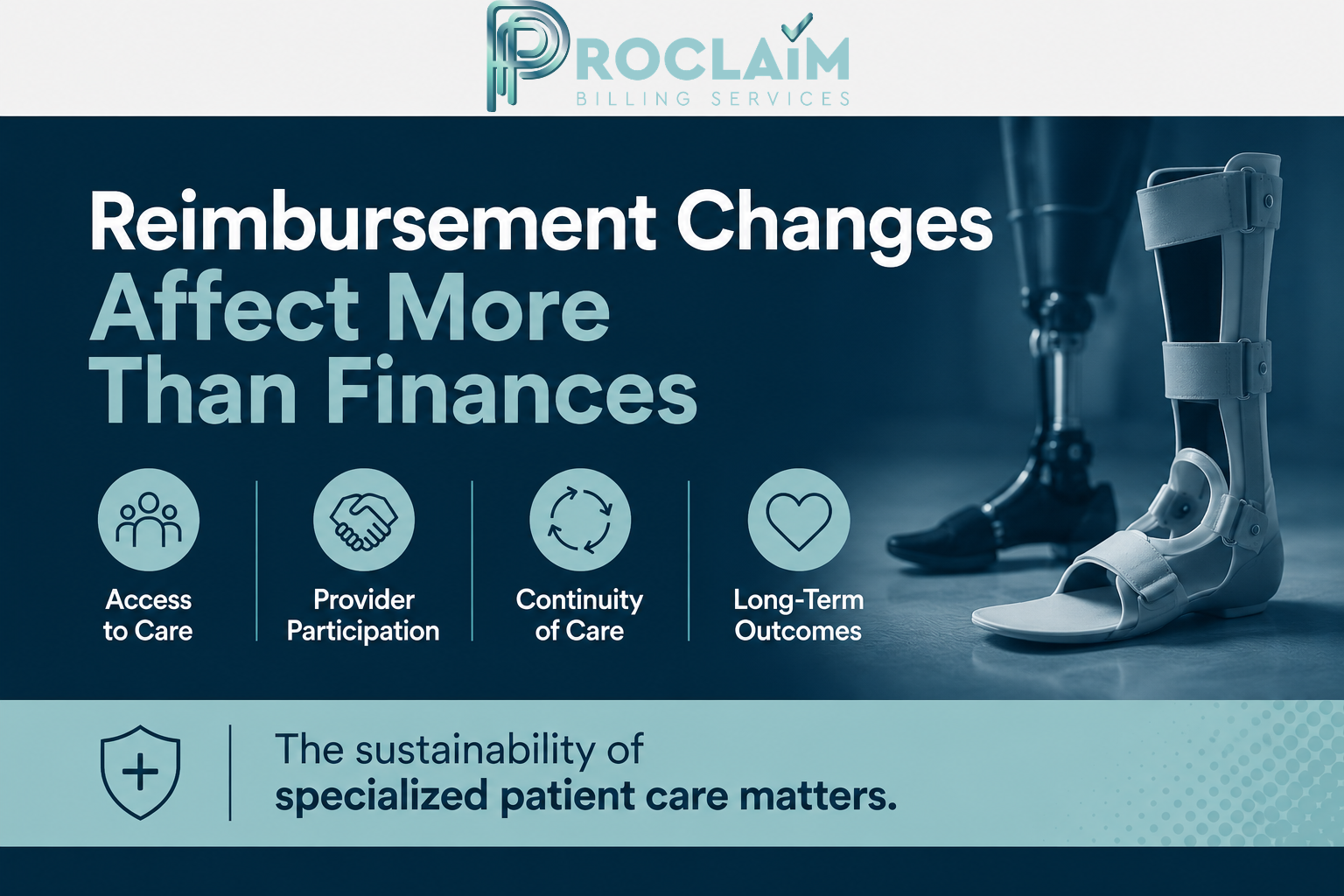
Why Unsustainable Reimbursement Impacts More Than Billing
Across the prosthetic and orthotic industry, many practices are facing increasing pressure from reimbursement changes and third-party administrative structures.
In some cases, reimbursement rates are being reduced to levels that practices describe as difficult to sustain long term.
Much of the conversation around these changes focuses on contracts and financial impact.
But the broader concern reaches beyond reimbursement itself.
It raises an important question about access to specialized care, and what happens when the systems supporting that care become increasingly strained.
Why Prosthetic & Orthotic Care Is Different
Prosthetic and orthotic care is highly specialized.
It involves clinical evaluation, device design, fitting, adjustments, follow-up, and ongoing patient management over time.
The work requires:
specialized clinical expertise
individualized treatment planning
long-term patient relationships
coordination across multiple stages of care
This is not commodity durable medical equipment.
The care process is highly customized and often deeply connected to a patient’s mobility, independence, and long-term quality of life.
What Happens When Reimbursement Drops Too Far
When reimbursement pressure increases significantly, the impact extends beyond financial statements.
Practices begin operating with tighter margins and less operational flexibility. Small inefficiencies become harder to absorb. Staffing pressure increases. Delays and administrative burden become more difficult to manage.
Over time, this creates strain across the organization.
And when that strain becomes unsustainable, practices may be forced to make difficult decisions about capacity, staffing, locations, or payer participation.
The Impact on Patients
The most important impact is often the least discussed.
Patients.
When provider participation decreases or operational strain grows too high, patients may begin experiencing:
longer delays in receiving care
increased travel burdens to access specialized providers
disruption in continuity of care
reduced access to adjustments and long-term follow-up support
For many prosthetic and orthotic patients, continuity matters.
These are not one-time transactions.
Care often continues over months or years as patient needs evolve.
When access becomes more limited, the effects can extend well beyond reimbursement itself.
A Larger Industry Conversation
This is not simply a discussion about contracts or billing operations.
It is a broader conversation about how the industry maintains:
access to care
quality of care
long-term sustainability
in an environment where reimbursement pressure continues increasing.
Practices across the industry are working to adapt operationally while continuing to provide the level of care patients depend on.
And many leaders are asking the same question:
How do we preserve specialized care while maintaining sustainable operations behind it?
Looking Beyond Reimbursement Alone
Financial and operational conversations are important.
But at the center of this issue are the patients who rely on prosthetic and orthotic care to maintain mobility, independence, and quality of life.
Which is why this conversation extends beyond reimbursement alone.
It is ultimately about preserving access to specialized care for the people who depend on it.
—
The Proclaim Team